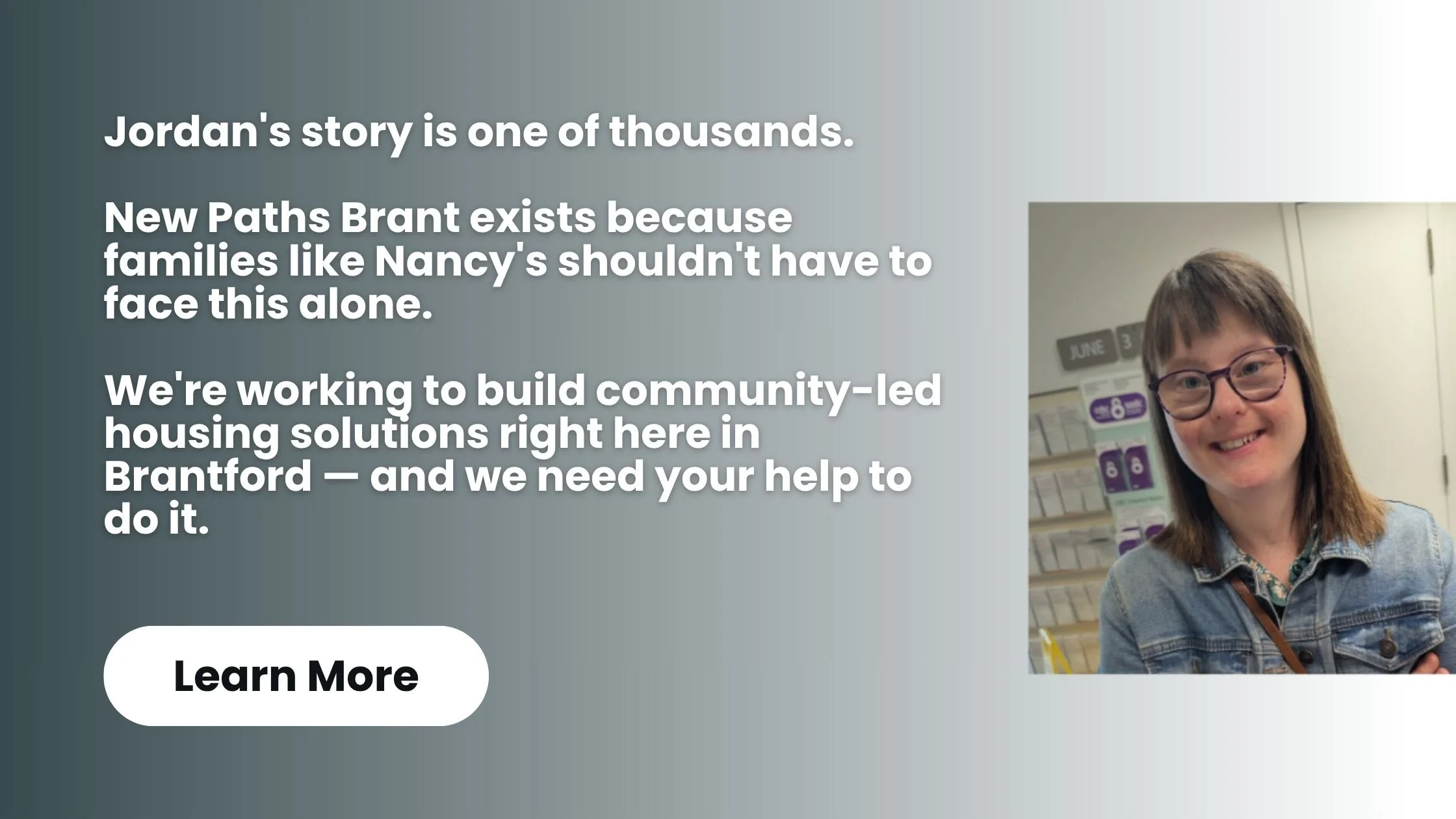
Running Out of Runway: Nancy's Story of 50 Years of Caregiving — and the Future She Fears for Jordan

Meet Jordan!
Jordan Seberras is 33 years old, cheerful, and capable of far more independence than she's ever had the chance to show. Her mother Nancy has devoted five decades to making sure she thrives. Now, with no supportive housing in sight, both of their futures feel uncertain.
As told by Nancy Tew Seberras
Mother of Jordan Seberras · Brantford, Ontario
Jordan Seberras goes with the flow. That's how she'd describe herself — and by all accounts, it's true. She never complains. She keeps her space tidy, she shows up for her teammates, and she lights up every room she enters. At 33, Jordan is a cheerleader, a bowler, a Special Olympics athlete, and a devoted helper to the people around her. She is, as her mother Nancy puts it simply, "a ray of sunshine." And yet for Jordan — and for Nancy — the most basic building block of an independent adult life remains out of reach. There is no supported home waiting for her. There is no plan. There is only the two of them, and a clock that keeps moving.
Tell us about Jordan. Who is she?
Jordan is a relatively quiet and happy young woman who loves spending time with friends and family. She participates in Special Olympics, bowling, cheerleading, and works out regularly with her coach. Jordan takes genuine pride in helping others — it's one of the things that makes her who she is. She never complains, and as she would say herself, she "goes with the flow." She is, without question, a ray of sunshine in my life.
What does your current housing situation look like?
Jordan lives at home with her father and me. She has her own apartment downstairs, which she loves — it gives her a real sense of independence, and she keeps it clean and neat. She's capable of making her own breakfast and lunch, though she relies on us for dinner. We love having her with us, but we worry about her increasing emotional and physical dependency on me in particular. That dependency grows stronger with each year, and I know that's not healthy for either of us in the long run.
"I am running out of runway. The options for Jordan to live in supportive housing are nowhere on the radar."
What does a typical day look like, and how does your housing situation affect it?
Because we live in the county, Jordan requires her father or me to drive her to everything — Crossing All Bridges, sports, social events, all of it. At home she has her routine, but she needs prompting to make sure she's completed everything. She is capable of being home alone for short stretches, but she doesn't like to be left for long periods — and certainly not overnight. The truth is, Jordan is capable of more independence than she's currently living. But she has learned to rely on my cues, my reminders, my presence. And the longer we live this way, the harder it becomes to imagine it differently.
What have you tried when it comes to finding housing?
Because supportive housing has been so unavailable, we actually purchased a home near CABLC with the hope that one day Jordan could live there and walk to the programs she loves. But finding long-term, affordable, and genuinely caring support workers for Jordan has been a hurdle we haven't been able to overcome. Owning the physical space is only part of the puzzle — without the right people in place to support her, the house sits waiting.
How would supportive housing improve Jordan's life — and yours?
Supportive housing would give Jordan the opportunity to become truly independent — because she would no longer be able to rely on me for every reminder and visual cue. I believe she would thrive, especially in an environment alongside friends. That kind of peer connection, that sense of belonging to a community of her own, is something she can't fully experience while living at home with her parents.
For me, having two other dependents to care for, Jordan's transition to independent living would give me the time and energy to show up more fully for them — and perhaps, for the first time in a very long time, for myself. More than anything, it would give me peace of mind: knowing that Jordan has made this transition while I am still here to support her through it, rather than leaving it to chance.
What worries you most about the future?
Jordan is only 33 years old. She will need care and support for 35 or more years beyond today. I lie awake wondering who will be there for her. Who will love her the way I do. Who will make sure she is truly thriving — not just surviving. I worry about who will be there to hold her hand at the very end of her life. These aren't abstract fears. They are the questions that keep me up at night, and they don't have answers yet.
What do you wish more people understood about what families like yours go through?
I wish people understood how much time, money, and physical and emotional energy caregivers pour into this every single day. The daily personal care. The scheduling, the driving, the appointments, the paperwork, the financial responsibility. The planning for a future we may not be alive to see. I wish people knew that many of us are still working into what should be our retirement years — because we are responsible for our adult children in ways that don't diminish with age. On a good day, it's manageable. On a bad day, it's overwhelming and exhausting. I have been doing this for 50 years, and it gets harder with each one that passes.
"I thought I would have the last years of my life for myself. Today, I don't believe that will ever be the case."
Is there anything else people need to hear?
When I was younger, I imagined the last chapter of my life would be my own. I pictured Jordan living independently and me finally able to relax, travel, and breathe. Today, I don't believe that will ever happen. I am running out of runway — and so is Jordan. The opportunities for her to live in supportive housing are nowhere on the radar. It isn't only about Jordan's tomorrows. Selfishly, it is also about my tomorrows. Right now, neither of them look very promising. And that is something people need to sit with — because it is the quiet reality of thousands of families, right here in our community.